
Membrane Desalination
This is the process of removing salt from sea or ground water sources. There are three common technology used for this application - the Membrane process, multi stage flash evaporation (MSF), multiple effect distillation (MED).
Membrane Desalination Capabilities
MEMBRANE DESALINATION
Membrane water treatment is widely utilized as an advanced treatment to ensure higher safety of various types of water or as a desalination process to obtain fresh water from seawater, etc.
Membranes are classified into Microfiltration (MF) Membrane, Ultrafiltration (UF) Membrane, Nanofiltration (NF) Membrane, and Reverse Osmosis (RO) Membrane according to their target separation substances and sizes.
Membranes are classified into Microfiltration (MF) Membrane, Ultrafiltration (UF) Membrane, Nanofiltration (NF) Membrane, and Reverse Osmosis (RO) Membrane according to their target separation substances and sizes.
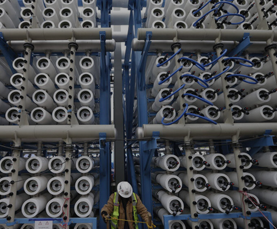
Forward Osmosis
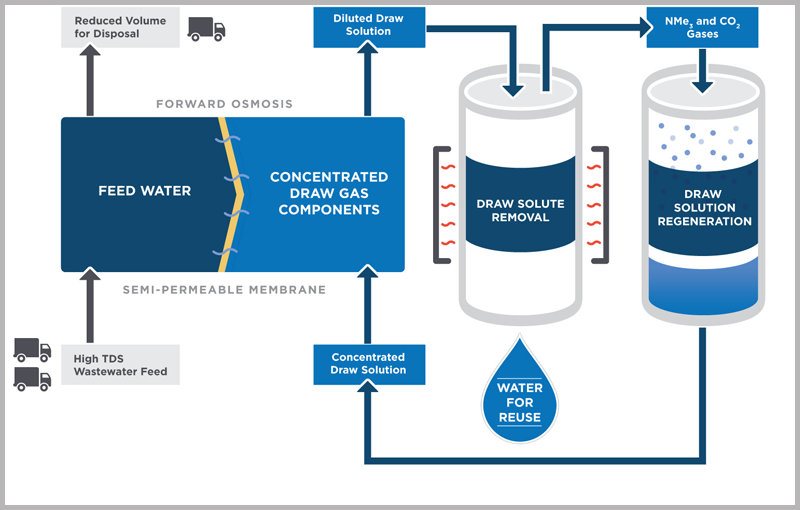
Forward osmosis is a water separation process that uses a semi-permeable membrane and the natural energy of osmotic pressure to separate water from dissolved solutes.
An osmotic concentration gradient is used to induce the flow of water through the membrane into a more concentrated “draw” solution.
An osmotic concentration gradient is used to induce the flow of water through the membrane into a more concentrated “draw” solution.
Reverse osmosis
Reverse osmosis occurs when the water is moved across the membrane against the concentration gradient, from lower concentration to higher concentration.
To illustrate, imagine a semi-permeable membrane with fresh water on one side and a concentrated aqueous solution on the other side.
To illustrate, imagine a semi-permeable membrane with fresh water on one side and a concentrated aqueous solution on the other side.
Micro filtration
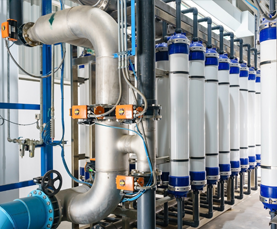
Microfiltration is a physical separation process where the feed fluid is passed through a microporous membrane.
We provide two modes; cross-flow, in which fluid travels parallel to the membrane, and dead-end, meaning fluid flows perpendicular to the membrane. It is mainly used for macromolecular scale separation and offers some of the highest flux rates among fluid separation.
We provide two modes; cross-flow, in which fluid travels parallel to the membrane, and dead-end, meaning fluid flows perpendicular to the membrane. It is mainly used for macromolecular scale separation and offers some of the highest flux rates among fluid separation.
Partner with Patron Chemical Engineering Today.
Let’s design the future of process innovation — safely, efficiently, and sustainably. Speak with our lead process engineers about your business goals.
Contact Us Now